
Universidad San Francisco de Quito
Quito, Ecuador
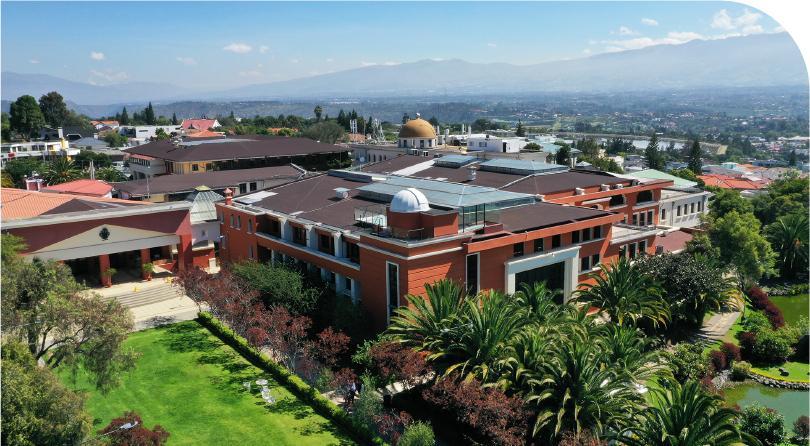
Universidad San Francisco de Quito (USFQ) is a private liberal arts university located in Quito, Ecuador. In addition to the main campus located in Cumbayá, USFQ has a satellite campus and research station in the Galápagos Islands and a biological field station “Tiputini Biodiversity Station” in the Amazon basin.
We believe in freedom as a fundamental human characteristic, and in training students to become well-rounded “world citizens”, leaders and entrepreneurs. As a research-centric university, USFQ has the highest number of PhDs in the country; a strength we leverage across all subjects.
USFQ is truly an International University and is a leader in the region. Ranked #1 University in Ecuador and #51 in Latin America (2018 QS University Rankings). We currently have over 9,000 students enrolled of which 1,000 are international students. We have over 100 Bilateral Partnerships for Research and Exchange, as well participate as members of prestigious International Networks, for example Berklee School of Music, Paul Bocuse, Global Liberal Arts Alliance, Hemispheric University Consortium and now, The Association for the Pacific Rim. Our faculty members represent 30 countries and 5 continents. We have both ABBET and AMBA accreditation.
Click here for university website.

VSE Season 2, 2025-26Courses offered by Universidad San Francisco de Quito
Important - Read Before Applying
Before applying, please make sure you understand the following enrolment restrictions set by the course offering university:
Applicants must submit this additional application form from the course offering university immediately after completing the VSE application form.
Application Deadline
Students must submit an application to the VSE Central Office before:
Dec 15, 2025 12:00 noon Hong Kong Time (UTC+8)
Academic Requirements
Before applying, please make sure you have fulfilled the course offering university's academic requirements listed below:
1. GPA 2.5 or above
For more details, please contact the VSE coordinator at Universidad San Francisco de Quito.
Language Proficiency Requirements
Before applying, please make sure you have fulfilled the course offering university's English language proficiency requirements listed below:
Recommended minimum of four semesters of college-level Spanish and/or English
For more details, please contact the VSE coordinator at Universidad San Francisco de Quito.
Course Information
Course information posted on this page are provided by the course offering university and may be changed or updated anytime without prior notice.
Click on the course titles to reveal full course details:
| Number of Credits | 3 | ||
| Offering Department | College of Biological and Environmental Sciences | ||
| Course Teacher | Gutiérrez Granja, Bernardo Miguel | ||
| Language of Instruction | English | ||
| First Day of Class | Jan 12, 2026 | ||
| Last Day of Class | Mar 8, 2026 | ||
| Course Component | Tutorial | ||
| Mode of Teaching | Asynchronous | ||
| Meeting Time | Self Paced | ||
| Time Zone | UTC−05 | ||
| Course Description | This course is designed to provide students from various academic majors with basic biological principles and their practical applications in fields including Evolution, Ecology, Behavior, Population Dynamics, Ecosystems, Conservation, and Contemporary Environmental Challenges. Additionally, the course is intended to provide students with a broad perspective of the diversity of living organisms that inhabit the Earth. | ||
| Course Outline | |||
| Course Prerequisites/Restrictions | Recommended minimum of four semesters of college-level English | ||
| Points to Note for Students | Students will use D2L to follow the class | ||
| Fees to be Borne by Students | N/A | ||
| Number of Credits | 3 | ||
| Offering Department | College of Biological and Environmental Sciences | ||
| Course Teacher | Cobo Andrade, Maria Mercedes | ||
| Language of Instruction | English | ||
| First Day of Class | Mar 16, 2026 | ||
| Last Day of Class | May 10, 2026 | ||
| Course Component | Tutorial | ||
| Mode of Teaching | Asynchronous | ||
| Meeting Time | Self Paced | ||
| Time Zone | UTC−05 | ||
| Course Description | This course is designed to provide students from various academic majors with basic biological principles and their practical applications in fields including Evolution, Ecology, Behavior, Population Dynamics, Ecosystems, Conservation, and Contemporary Environmental Challenges. Additionally, the course is intended to provide students with a broad perspective of the diversity of living organisms that inhabit the Earth. | ||
| Course Outline | |||
| Course Prerequisites/Restrictions | Recommended minimum of four semesters of college-level English | ||
| Points to Note for Students | Students will use D2L to follow the class | ||
| Fees to be Borne by Students | N/A | ||
| Number of Credits | 3 | ||
| Offering Department | College of Biological and Environmental Sciences | ||
| Course Teacher | Chaves Cevallos, Jaime Alfonso | ||
| Language of Instruction | Spanish | ||
| First Day of Class | Mar 16, 2026 | ||
| Last Day of Class | May 10, 2026 | ||
| Course Component | Tutorial | ||
| Mode of Teaching | Asynchronous | ||
| Meeting Time | Self Paced | ||
| Time Zone | UTC−05 | ||
| Course Description | En este curso aprenderemos las funciones básicas de un ecosistema, la biodiversidad, cambio climático, sostenibilidad y conservación de la biodiversidad del Ecuador. Para ello empezaremos entendiendo los conceptos básicos de ecología para poder entender los patrones de biodiversidad. Hablaremos de las biorregiones del Ecuador, sus recursos disponibles y amenazas y cambio climático. Finalmente, usaremos todo este conocimiento para entender la importancia de la sostenibilidad y la conservación de la biodiversidad. Una de las bases fundamentales para garantizar el desarrollo de una sociedad es el aprovechamiento racional y sostenible de los recursos naturales renovables, particularmente en un país con tanta vocación agraria, forestal y marina como el Ecuador y una enorme diversidad biológica y ecológica. Durante el curso, tendremos una salida de campo donde se evidenciará y pondrá en práctica el conocimiento adquirido. | ||
| Course Outline | |||
| Course Prerequisites/Restrictions | Recommended minimum of four semesters of college-level Spanish | ||
| Points to Note for Students | Students will use D2L to follow the class | ||
| Fees to be Borne by Students | N/A | ||
| Number of Credits | 3 | ||
| Offering Department | College of Social Sciences and Humanities | ||
| Course Teacher | Enrique Wong | ||
| Language of Instruction | English | ||
| First Day of Class | Jan 12, 2026 | ||
| Last Day of Class | Mar 8, 2026 | ||
| Course Component | Tutorial | ||
| Mode of Teaching | Asynchronous | ||
| Meeting Time | Self Paced | ||
| Time Zone | UTC−05 | ||
| Course Description | Although The Catcher in the Rye is probably the best known of J.D. Salinger’s works, he is also famous for other pieces of short fiction that somehow shed some light on the life of this secretive and elusive author. Franny and Zooey, and Nine Stories bring to life magnificent characters that together with Holden Caulfield form the moral universe of this evanescent author. Through the analysis of selected works, J.D. Salinger: Life and Fiction will establish a parallel between fiction characters and the real life of one of the most intriguing and influential literary legends in 20th century American Literature. | ||
| Course Outline | |||
| Course Prerequisites/Restrictions | Recommended minimum of four semesters of college-level English | ||
| Points to Note for Students | Students will use D2L to follow the class | ||
| Fees to be Borne by Students | N/A | ||
| Number of Credits | 3 | ||
| Offering Department | College of Social Sciences and Humanities | ||
| Course Teacher | Enrique Wong | ||
| Language of Instruction | English | ||
| First Day of Class | Mar 16, 2026 | ||
| Last Day of Class | May 10, 2026 | ||
| Course Component | Tutorial | ||
| Mode of Teaching | Asynchronous | ||
| Meeting Time | Self Paced | ||
| Time Zone | UTC−05 | ||
| Course Description | Although William Faulkner is known for the complexity of his novels about the human condition, his short stories also stand out for their psychological depth, innovative use of language, and portrayal of the American South. Through reading, writing, and discussion, this course will explore how Faulkner, through his short stories set in the fictional county of Yoknapatawpha, helps us understand a regional culture that transcends the geographical framework of his native South. | ||
| Course Outline | |||
| Course Prerequisites/Restrictions | Recommended minimum of four semesters of college-level English | ||
| Points to Note for Students | Students will use D2L to follow the class | ||
| Fees to be Borne by Students | N/A | ||
| Number of Credits | 3 | ||
| Offering Department | College of Music | ||
| Course Teacher | Bianchini Gianni | ||
| Language of Instruction | English | ||
| First Day of Class | Jan 12, 2026 | ||
| Last Day of Class | May 14, 2026 | ||
| Course Component | Lecture | ||
| Mode of Teaching | Synchronous | ||
| Meeting Time | Mon & Wed 1000-1120 | ||
| Time Zone | UTC−05 | ||
| Course Description | The Evolution of Jazz is a course which consists mainly of lectures by the teacher and audio recordings of jazz pieces that showcase the genre's different stages throughout history. This course is compulsory for students of contemporary music performance, and it is optional for students of other majors. | ||
| Course Outline | |||
| Course Prerequisites/Restrictions | Recommended minimum of four semesters of college-level English | ||
| Points to Note for Students | Students will use D2L to follow the class | ||
| Fees to be Borne by Students | N/A | ||
| Number of Credits | 3 | ||
| Offering Department | College of Social Sciences and Humanities | ||
| Course Teacher | Cecilia Conde | ||
| Language of Instruction | English | ||
| First Day of Class | Jan 12, 2026 | ||
| Last Day of Class | Mar 8, 2026 | ||
| Course Component | Tutorial | ||
| Mode of Teaching | Asynchronous | ||
| Meeting Time | Self Paced | ||
| Time Zone | UTC−05 | ||
| Course Description | In this course, that is open to undergraduates of all majors, the following topics are explored at an introductory level: (a) the nature, implications, and consequences of human conflict; (b) the main current theories regarding its causes; (c) so-called ‘strategies’, that are the ways in which we humans address conflict (avoidance, confrotation, yielding, management and/or resolution); (d) escalation of conflct; (e) the tendency for escalation to become irreversible; (f) the main processes for de-escalation, management and resolution, including pre-negotiation and direct negotiation between or among the parties; (g) reconciliation between or among parties that were previously in conflict; and (h) various forms of impartial third-party intervention. | ||
| Course Outline | |||
| Course Prerequisites/Restrictions | Recommended minimum of four semesters of college-level English | ||
| Points to Note for Students | Students will use D2L to follow the class | ||
| Fees to be Borne by Students | N/A | ||
Before Making an Application
Make sure you have thoroughly read the information on this page and the Season page before making an application. If you have a question, email us at [email protected] or contact the VSE Coordinators at your home university or course offering university.
