
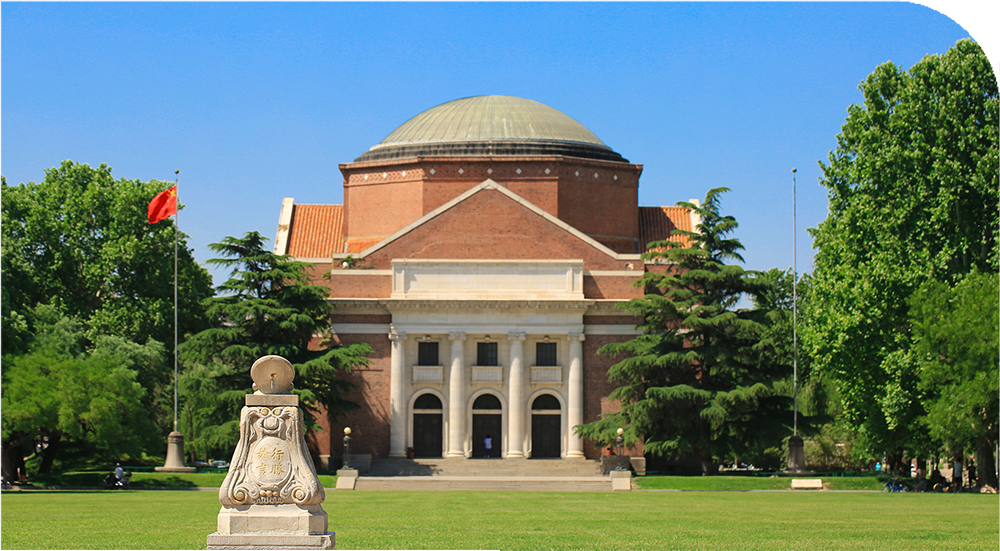
Tsinghua University
Beijing, China
Tsinghua University is situated around Tsinghua garden, originally an imperial garden of Qing dynasty, in the northwestern suburbs of Beijing. The University was instituted in 1911, originally under the name of Tsinghua Xuetang, as a preparatory school for students who would be sent by the government to study in the United States.
Tsinghua University is one of the national key universities in China, comprising disciplines in sciences, engineering, management, humanities and social sciences, law, arts and design, as well as medical science. 49 disciplines are listed as National Key Disciplines. There are 13 schools and 54 departments, offering 61 Bachelor’s programs, 198 Master’s programs and 181 Doctoral programs.
At present, Tsinghua has over 30,000 undergraduate and master’s students, and 5,156 PhD candidates. It has over 2,800 faculty members, including 34 academicians of the Chinese Academy of Sciences and 30 academicians of the Chinese Academy of Engineering. There are also one Nobel Laureate and one Turing Laureate among the faculty. Tsinghua University’s main research areas are information science and technology, life science, new materials, energy, environmental science, advanced manufacturing.
Click here for university website.

VSE Season 2, 2025-26Courses offered by Tsinghua University
Important - Read Before Applying
Before applying, please make sure you understand the following enrolment restrictions set by the course offering university:
Each student can apply and enroll in ONE academic course offered by Tsinghua University at VSE Season 2, 2025-26 only. If you have submitted two applications to Tsinghua University courses, the VSE Central Office will withdraw the SECOND application without prior notice. If you wish to change your course selection after making the first application, please make a request by emailing [email protected].
Application Deadline
Students must submit an application to the VSE Central Office before:
Jan 25, 2026 12:00 noon Hong Kong Time (UTC+8)
Course Information
Course information posted on this page are provided by the course offering university and may be changed or updated anytime without prior notice.
Click on the course titles to reveal full course details:
| Number of Credits | 3 | ||
| Offering Department | Department of Civil Engineering | ||
| Course Teacher | Huiyong Ban | ||
| Language of Instruction | English | ||
| First Day of Class | Feb 25, 2026 | ||
| Last Day of Class | Jun 12, 2026 | ||
| Course Component | Lecture | ||
| Mode of Teaching | Synchronous | ||
| Meeting Time | Mon 0950-1215 | ||
| Time Zone | UTC+08 | ||
| Course Description | This course is one of the most important specialised courses for undergraduates majoring in civil engineering. It mainly introduces principles of mechanism and design methods by means of lectures. More specifically, the contents include: i) characteristics and advantages of steel structures, their development and application as well as basic requirements for their design; ii) manufacturing process, mechanical properties and selection of steel structural materials; iii) connections in steel structures, and fundamental behaviour, mechanical analysis, design method and configuration requirements of both welded and bolted connections; iv) failure modes of steel members subjected to axial loadings, design theories of their strength, stiffness, overall and local buckling, as well as design and checking of their cross-sections; v) flexural behaviour of steel members including calculation of their strength, stiffness, flexural-torsional buckling and local buckling within flanges and web, as well as design of cross-sections and configuration requirements of hot-rolled and welded steel beams; vi) mechanical performance of steel members subjected to bending with tension or compression in combination, including calculation method of their strength and buckling and configuration details; vii) typical joints in steel frame structures and their loading capacities, configurations. National standards are also incorporated in this course, including the China's one and the European and American ones. | ||
| Course Outline | |||
| Course Prerequisites/Restrictions | N/A | ||
| Points to Note for Students | N/A | ||
| Fees to be Borne by Students | N/A | ||
| Number of Credits | 2 | ||
| Offering Department | Department of Electronic Engineering | ||
| Course Teacher | Yuan Shen | ||
| Language of Instruction | English | ||
| First Day of Class | Feb 25, 2026 | ||
| Last Day of Class | Jun 12, 2026 | ||
| Course Component | Lecture | ||
| Mode of Teaching | Synchronous | ||
| Meeting Time | Tue 0950-1125 | ||
| Time Zone | UTC+08 | ||
| Course Description | This course will introduce students to the modelling, quantification, and analysis of uncertainty. Topics covered include: formulation and solution in sample space, random variables, transform techniques, simple stochastic processes and their probability distributions, and limit theorems. | ||
| Course Outline | |||
| Course Prerequisites/Restrictions | N/A | ||
| Points to Note for Students | N/A | ||
| Fees to be Borne by Students | N/A | ||
| Number of Credits | 3 | ||
| Offering Department | Department of Electronic Engineering | ||
| Course Teacher | Cheng Ma | ||
| Language of Instruction | English | ||
| First Day of Class | Feb 25, 2026 | ||
| Last Day of Class | Jun 12, 2026 | ||
| Course Component | Lecture | ||
| Mode of Teaching | Synchronous | ||
| Meeting Time | Fri 0950-1215 | ||
| Time Zone | UTC+08 | ||
| Course Description | Electromagnetic field and wave is the theoretical foundation for the studies of electrical circuits, optics, photonics, microwave systems, etc. It provides the basic method and tool for understanding, analyzing, and solving problems involving electromagnetism. The course will introduce vector analysis, Maxwell's equations, Lorentz force, electrostatics and magnetostatics, electrodynamics, propagation of EM waves, and radiation. Beside basic principles, the course will introduce a number of examples including electrical circuits, optical and RF waveguides, antenna, and electrical measurement in biomedical applications, such that the students can implement the theory to solve real-world problems. | ||
| Course Outline | |||
| Course Prerequisites/Restrictions | N/A | ||
| Points to Note for Students | N/A | ||
| Fees to be Borne by Students | N/A | ||
| Number of Credits | 2 | ||
| Offering Department | School of Humanities | ||
| Course Teacher | Dag Westerståhl | ||
| Language of Instruction | English | ||
| First Day of Class | Feb 25, 2026 | ||
| Last Day of Class | Apr 17, 2026 | ||
| Course Component | Lecture | ||
| Mode of Teaching | Synchronous | ||
| Meeting Time | Mon & Wed 1520-1655 | ||
| Time Zone | UTC+08 | ||
| Course Description | The course gives an overview of classical meta-logical results, in particular, Godel's completeness and incompleteness theorems, Church- Turing's proof of the undecidability of first-order logic, and Tarski's theorem on the undefinability of truth. After a recapitulation of the syntax and semantics of first-order logic, Henkin's proof of completeness, in terms of syntactic models and maximal consistent sets, is presented. Philosophical and logical consequences of the result and its proof are discussed, with some glimpses from model theory. The course then presents the notions of complete and incomplete theories, as well as decidability of theories. After an overview of the philosophical and mathematical background in the early 20th century, including Hilbert'sProgram, the incompleteness theorems and related results, and the ideas behind their proofs, are presented at an informal level. The remainder of the course fills in some of the details. The course presentation focuses on important concepts and ideas, philosophical as well as mathematical, but also gives pointers to the technical details. | ||
| Course Outline | |||
| Course Prerequisites/Restrictions | N/A | ||
| Points to Note for Students | N/A | ||
| Fees to be Borne by Students | N/A | ||
| Number of Credits | 2 | ||
| Offering Department | School of Humanities | ||
| Course Teacher | Jeremy Seligman | ||
| Language of Instruction | English | ||
| First Day of Class | Apr 20, 2026 | ||
| Last Day of Class | Jun 12, 2026 | ||
| Course Component | Lecture | ||
| Mode of Teaching | Synchronous | ||
| Meeting Time | Mon & Wed 1520-1655 | ||
| Time Zone | UTC+08 | ||
| Course Description | Among branches of modern logic, modal logic provides a nice balance of expressivity and complexity, allowing it to be applied widely and extensively in many fields ranging from humanities to software design. In this course, ideas and methods of modal logic will be introduced along with its famous applications in modeling time, knowledge, necessity, and social behaviors. In this thread, student will be led into environments similar to research, in which ideas and needs from theoretical side and practical side frequently interact. Pointers will be given to standard textbooks/handbooks as well as notable papers, and with knowledge and skills introduced in this course, students with further interests should in principle be able to explore by their own. This course aims to student who more or less have learnt some logic, but this is not strictly required. | ||
| Course Outline | |||
| Course Prerequisites/Restrictions | N/A | ||
| Points to Note for Students | N/A | ||
| Fees to be Borne by Students | N/A | ||
| Number of Credits | 3 | ||
| Offering Department | Astronomy | ||
| Course Teacher | ORMEL Christiaan Wessel | ||
| Language of Instruction | English | ||
| First Day of Class | Feb 25, 2026 | ||
| Last Day of Class | Jun 12, 2026 | ||
| Course Component | Lecture | ||
| Mode of Teaching | Synchronous | ||
| Meeting Time | Thu 1920-2145 | ||
| Time Zone | UTC+08 | ||
| Course Description | Stars are the objects that have enabled us to learn how our universe works. There may be over 1022 stars in the universe and modern estimates indicate that most of these stars are accompanied by planets. This course aims to understand the formation, structure, and observational properties of stars and planets from elementary physical principles. Questions that will be addressed include: why do stars have a mass of about 1 solar mass, which conditions must be met for nuclear fusion, why are stars stable, how do planets form and what determines the size and composition of planets, how can we detect exoplanets, how do planetary bodies influence each other? In addressing these questions, the student will learn and apply a great number of concepts that shape our modern understanding of these objects. This course is organized along seven modules: 1. Light 2. Exoplanet detection techniques 3. Matter under astrophysical conditions 4. Planet and stellar Birth 5. Stellar Evolution and Death 6. Atmospheres 7. Planet Dynamics Student participation and problem sets play an instrumental part throughout the course. The classical instruction will be further supplemented by presentations mini-project by students on a topic of their choosing related to the field of Stars and Planets. | ||
| Course Outline | |||
| Course Prerequisites/Restrictions | N/A | ||
| Points to Note for Students | N/A | ||
| Fees to be Borne by Students | N/A | ||
| Number of Credits | 3 | ||
| Offering Department | Astronomy | ||
| Course Teacher | CUI WEI KEVIN | ||
| Language of Instruction | English | ||
| First Day of Class | Feb 25, 2026 | ||
| Last Day of Class | Jun 12, 2026 | ||
| Course Component | Lecture | ||
| Mode of Teaching | Synchronous | ||
| Meeting Time | Tue 0950-1215 | ||
| Time Zone | UTC+08 | ||
| Course Description | The course covers key observational techniques, astronomical phenomena, and related physical processes in the field of high energy astrophysics. | ||
| Course Outline | |||
| Course Prerequisites/Restrictions | N/A | ||
| Points to Note for Students | This course is primarily designed for graduate students at Tsinghua University. However, undergraduate students are also welcome to enroll in this course. | ||
| Fees to be Borne by Students | N/A | ||
Before Making an Application
Make sure you have thoroughly read the information on this page and the Season page before making an application. If you have a question, email us at [email protected] or contact the VSE Coordinators at your home university or course offering university.
