
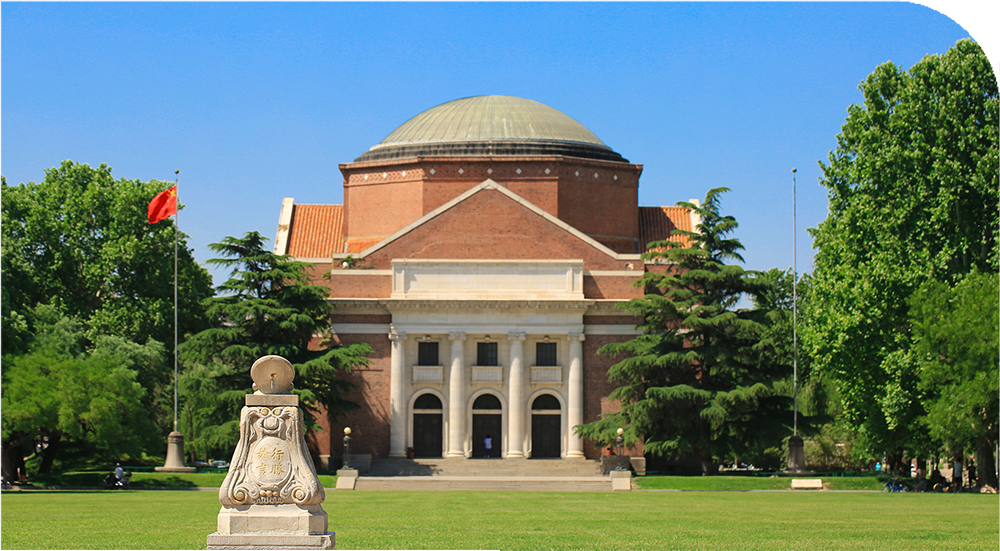
Tsinghua University
Beijing, China
Tsinghua University is situated around Tsinghua garden, originally an imperial garden of Qing dynasty, in the northwestern suburbs of Beijing. The University was instituted in 1911, originally under the name of Tsinghua Xuetang, as a preparatory school for students who would be sent by the government to study in the United States.
Tsinghua University is one of the national key universities in China, comprising disciplines in sciences, engineering, management, humanities and social sciences, law, arts and design, as well as medical science. 49 disciplines are listed as National Key Disciplines. There are 13 schools and 54 departments, offering 61 Bachelor’s programs, 198 Master’s programs and 181 Doctoral programs.
At present, Tsinghua has over 30,000 undergraduate and master’s students, and 5,156 PhD candidates. It has over 2,800 faculty members, including 34 academicians of the Chinese Academy of Sciences and 30 academicians of the Chinese Academy of Engineering. There are also one Nobel Laureate and one Turing Laureate among the faculty. Tsinghua University’s main research areas are information science and technology, life science, new materials, energy, environmental science, advanced manufacturing.
Click here for university website.

VSE Season 1, 2025-26Courses offered by Tsinghua University
Important - Read Before Applying
Before applying, please make sure you understand the following enrolment restrictions set by the course offering university:
Each student can apply and enrol in ONE VSE course offered by Tsinghua University in VSE Season 1, 2025-26 only. If you have submitted two applications to Tsinghua University's courses, the VSE Central Office will withdraw the SECOND application without prior notice. If you wish to change your course selection after making the first application, please make a request by emailing [email protected].
Application Deadline
Students must submit an application to the VSE Central Office before:
Aug 17, 2025 12:00 noon Hong Kong Time (UTC+8)
Course Information
Course information posted on this page are provided by the course offering university and may be changed or updated anytime without prior notice.
Click on the course titles to reveal full course details:
| Number of Credits | 2 | ||
| Offering Department | Department of Astronomy | ||
| Course Teacher | CUI WEI KEVIN | ||
| Language of Instruction | English | ||
| First Day of Class | Sep 16, 2025 | ||
| Last Day of Class | Dec 30, 2025 | ||
| Course Component | Lecture | ||
| Mode of Teaching | Synchronous | ||
| Meeting Time | Tue 1330-1505 | ||
| Time Zone | UTC+08 | ||
| Course Description | Please refer to the attachment. | ||
| Course Outline | |||
| Course Prerequisites/Restrictions | College physics | ||
| Points to Note for Students | N/A | ||
| Fees to be Borne by Students | N/A | ||
| Number of Credits | 1 | ||
| Offering Department | Fundamental Industry Training Center | ||
| Course Teacher | Zhu Feng | ||
| Language of Instruction | English | ||
| First Day of Class | Sep 17, 2025 | ||
| Last Day of Class | Nov 15, 2025 | ||
| Course Component | Lecture | ||
| Mode of Teaching | Synchronous | ||
| Meeting Time | Wed 1920-2055 | ||
| Time Zone | UTC+08 | ||
| Course Description | Please refer to the attachment. | ||
| Course Outline | |||
| Course Prerequisites/Restrictions | No prerequisite, but English fluency is mandatory. | ||
| Points to Note for Students | N/A | ||
| Fees to be Borne by Students | N/A | ||
| Number of Credits | 3 | ||
| Offering Department | Department of Electronic Engineering | ||
| Course Teacher | Li Xueqing | ||
| Language of Instruction | English | ||
| First Day of Class | Sep 15, 2025 | ||
| Last Day of Class | Dec 29, 2025 | ||
| Course Component | Lecture | ||
| Mode of Teaching | Synchronous | ||
| Meeting Time | Mon 1920-2145 | ||
| Time Zone | UTC+08 | ||
| Course Description | Please refer to the attachment. | ||
| Course Outline | |||
| Course Prerequisites/Restrictions | The students need to learn basic programing and circuit theory before taking this course. | ||
| Points to Note for Students | N/A | ||
| Fees to be Borne by Students | N/A | ||
| Number of Credits | 2 | ||
| Offering Department | Department of Electronic Engineering | ||
| Course Teacher | Lin Xing | ||
| Language of Instruction | English | ||
| First Day of Class | Sep 19, 2025 | ||
| Last Day of Class | Jan 2, 2026 | ||
| Course Component | Lecture | ||
| Mode of Teaching | Synchronous | ||
| Meeting Time | Fri 0950-1125 | ||
| Time Zone | UTC+08 | ||
| Course Description | Please refer to the attachment. | ||
| Course Outline | |||
| Course Prerequisites/Restrictions | Designed for absolute beginners; no prerequisites. Open to all first-year students. | ||
| Points to Note for Students | N/A | ||
| Fees to be Borne by Students | N/A | ||
| Number of Credits | 3 | ||
| Offering Department | School of Economics and Management | ||
| Course Teacher | Wu Binzhen | ||
| Language of Instruction | English | ||
| First Day of Class | Sep 17, 2025 | ||
| Last Day of Class | Dec 31, 2025 | ||
| Course Component | Lecture | ||
| Mode of Teaching | Synchronous | ||
| Meeting Time | Wed 0950-1215 | ||
| Time Zone | UTC+08 | ||
| Course Description | Public Finance studies the role of the public sector in the economy. In this course, we will study the economic foundations that justify the existence of the public sector and the economic theories that describe its role. We will consider when governments should intervene in the economy and how they should do so, including the options they have and the effects of alternative policies. The focus is on government taxation and spending activities. We will also study how to evaluate government policies in practice, including how these policies affect individual and corporate decision-making and welfare. | ||
| Course Outline | |||
| Course Prerequisites/Restrictions | Intermediate Microeconomics; Calculus | ||
| Points to Note for Students | N/A | ||
| Fees to be Borne by Students | N/A | ||
| Number of Credits | 3 | ||
| Offering Department | School of Economics and Management | ||
| Course Teacher | Liu Shuo | ||
| Language of Instruction | English | ||
| First Day of Class | Sep 18, 2025 | ||
| Last Day of Class | Jan 1, 2026 | ||
| Course Component | Lecture | ||
| Mode of Teaching | Synchronous | ||
| Meeting Time | Thu 0950-1215 | ||
| Time Zone | UTC+08 | ||
| Course Description | Empirical Finance is a course for senior undergraduate students who are interested in applying real data to test classical asset pricing theories and also the applications of econometric methods to financial problems. This course mainly contains two parts: “empirical asset pricing” and “applied econometrics”. The first part discusses how to apply real data and simulation methods to test classical financial theories, including equity valuation, portfolio management analysis, CAPM model, Fama-Macbeth regression, Fama-French-Carhart factor model, Arbitrage Pricing Theory, and multi-factor pricing models for fixed income securities. The second part helps students review basic econometric theory, and further talks about more advanced time-series and panel data models, including ARIMA model, GARCH model, fixed/random effect models, and varying-coefficient models. Specifically, this course focuses on the application of econometric models to real financial or economic problems, for example, this course will cover the difference-in-difference analysis, solving endogeneity problem, model specification and selection. After taking this course, students are expected to obtain a general idea about how to write a research proposal and how to construct appropriate | ||
| Course Outline | |||
| Course Prerequisites/Restrictions | Introduction to econometrics, Introduction to investments, Introduction to corporate finance | ||
| Points to Note for Students | N/A | ||
| Fees to be Borne by Students | N/A | ||
| Number of Credits | 3 | ||
| Offering Department | School of Economics and Management | ||
| Course Teacher | Shi Xinzheng | ||
| Language of Instruction | English | ||
| First Day of Class | Sep 16, 2025 | ||
| Last Day of Class | Dec 30, 2025 | ||
| Course Component | Lecture | ||
| Mode of Teaching | Synchronous | ||
| Meeting Time | Tue 1330-1605 | ||
| Time Zone | UTC+08 | ||
| Course Description | Please refer to the attachment. | ||
| Course Outline | |||
| Course Prerequisites/Restrictions | Intermediate Microeconomics, Econometrics | ||
| Points to Note for Students | N/A | ||
| Fees to be Borne by Students | N/A | ||
| Number of Credits | 3 | ||
| Offering Department | School of Economics and Management | ||
| Course Teacher | Cao Jing | ||
| Language of Instruction | English | ||
| First Day of Class | Sep 15, 2025 | ||
| Last Day of Class | Dec 29, 2025 | ||
| Course Component | Lecture | ||
| Mode of Teaching | Synchronous | ||
| Meeting Time | Mon 1330-1605 | ||
| Time Zone | UTC+08 | ||
| Course Description | This course is an introduction of Environmental and Natural Resource Economics. The objective of this course is for students to learn how basic economic theory can be used to understand and analyze environmental pollution and resource degradation problems. The course covers both conceptual and methodological topics and recent applications in China, US and European countries. Examples of local, regional, national and international environmental and natural resource issues are presented and discussed. This course is structured into four parts. The first part of this course is an introduction to the basic principles of environmental and resource economics; cost and benefit analysis. In the second part the focus is on environmental economics and policy, including economics of pollution control, valuing the environment, regional and global air pollution, water pollution and so forth. The third part is focused on natural resource economics, both renewable and non-renewable resources. The last part is on sustainable development and macroeconomic aspect of environmental policy. | ||
| Course Outline | |||
| Course Prerequisites/Restrictions | Intermediate Microeconomics is required for taking this course. | ||
| Points to Note for Students | N/A | ||
| Fees to be Borne by Students | N/A | ||
Before Making an Application
Make sure you have thoroughly read the information on this page and the Season page before making an application. If you have a question, email us at [email protected] or contact the VSE Coordinators at your home university or course offering university.
