
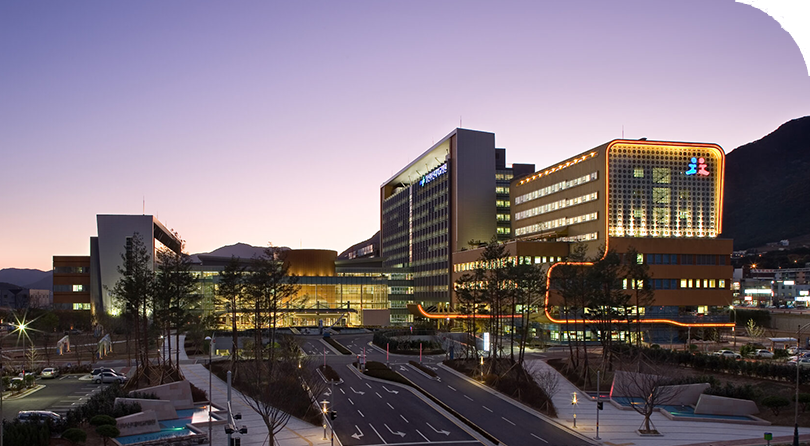
Pusan National University
Busan, South Korea
Pusan National University (PNU) is the top Korean flagship national university and Asia’s premier comprehensive institution of higher education and a leader in research and teaching. PNU consists of four campuses in Busan and Gyeongnam area, and has two university hospitals providing high-quality medical services to the local community.
Established in May 1946, PNU provides educational opportunities in almost all areas of study and supports the needs of quality higher education in the southeastern region of the country. PNU offers a competitive curriculum in the social sciences, humanities, natural science, engineering, and medicine. PNU offers 115 majors in an undergraduate course and 215 majors in a graduate course.
PNU has been the No. 1 national University in research and educational competency, and its tradition and ability are estimated highly. More than 240,000 PNU alumni have taken responsibility for the development of the communities and the country, and about 36,000 students, 2,300 faculty members are working as one to develop PNU, and institutions based on the principle of truth, freedom, and service.
PNU has embraced academic cooperation agreements with over 530 universities and institutions in 58 countries and regions in the World. In PNU around 2300 international students studying and researching from 98 countries. PNU coordinates professors and researchers, student exchange programs, short-term dispatch programs, and joint research programs.
Click here for university website.

VSE Season 2, 2025-26Courses offered by Pusan National University
Application Deadline
Students must submit an application to the VSE Central Office before:
Feb 11, 2026 12:00 noon Hong Kong Time (UTC+8)
Course Information
Course information posted on this page are provided by the course offering university and may be changed or updated anytime without prior notice.
Click on the course titles to reveal full course details:
| Number of Credits | 3 | ||
| Offering Department | INTERNATIONAL TRADE | ||
| Course Teacher | AHN YOUNG BIN | ||
| Language of Instruction | English | ||
| First Day of Class | Mar 3, 2026 | ||
| Last Day of Class | Jun 18, 2026 | ||
| Course Component | Lecture | ||
| Mode of Teaching | Synchronous | ||
| Meeting Time | Tue & Thu 1030-1145 | ||
| Time Zone | UTC+09 | ||
| Course Description | The aim of this course is to introduce students to the modern microeconomic theory. After this course, students should have a good understanding of how economists model individual consumer and firm behaviors and be able to use the models to explain and predict a wide range of observed economic phenomena. | ||
| Course Outline | |||
| Course Prerequisites/Restrictions | Principles of Economics | ||
| Points to Note for Students | Students who fail to attend at least two-thirds of total classes shall automatically receive an F grade. (PNU Regulation) | ||
| Fees to be Borne by Students | N/A | ||
| Number of Credits | 3 | ||
| Offering Department | Political Science & Diplomacy | ||
| Course Teacher | Haneol Lee | ||
| Language of Instruction | English | ||
| First Day of Class | Mar 3, 2026 | ||
| Last Day of Class | Jun 18, 2026 | ||
| Course Component | Lecture | ||
| Mode of Teaching | Synchronous | ||
| Meeting Time | Tue & Thu 1030-1145 | ||
| Time Zone | UTC+09 | ||
| Course Description | This course serves as an introduction to international politics and is open to students new to the field of International Relations. The three core objectives of this course are as follows: First, students will grasp the approximate concepts of international relations theories. This will involve an overview of the most traditional perspectives in international politics, including Realism, Liberalism (which emphasizes cooperation), and Constructivism (which focuses on ideational factors). Second, the course aims to enhance students' understanding of social sciences throughout its progression. Therefore, this lecture will emphasize the acquisition and expression of logical knowledge. Students are expected to recognize their deductive logic and develop sensitivity to the 'breakdown of logic.' Third, the course seeks to foster an empirical understanding. This objective involves a distinct intellectual process from the second. Deductive logic must be 'adjusted' when it is rationally judged to conflict with inductive reasoning. Consequently, the course will involve learning about empirical facts from various states and societies. In addition to the above objectives, two points require particular emphasis: First, the course will encompass both traditional perspectives in international politics. Initially, it will cover traditional themes of international relations, such as war and peace. Simultaneously, it will reflect the expansion of the scope of international politics, as suggested by the emergence of concepts such as 'global politics' and 'emerging security.' Thus, topics such as democratization, terrorism, the environment, health, and culture will be included in the discussions. Second, the course will review the history and theoretical knowledge of international political economy. In an era when interest in 'economic security' is growing amid the resurgence of great-power strategic competition, it is crucial to understand the past and present international economic order and to cultivate the ability to assess its resilience. | ||
| Course Outline | |||
| Course Prerequisites/Restrictions | N/A | ||
| Points to Note for Students | Students who fail to attend at least two-thirds of total classes shall automatically receive an F grade. (PNU Regulation) | ||
| Fees to be Borne by Students | N/A | ||
Before Making an Application
Make sure you have thoroughly read the information on this page and the Season page before making an application. If you have a question, email us at [email protected] or contact the VSE Coordinators at your home university or course offering university.
